
By Jonny Greenspan, Co-Founder & CTO, Harmonyze
By now you've probably seen that Anthropic pulled its two most powerful AI models—Fable 5 and Mythos 5—offline last week, after a government export-control directive barred foreign nationals from accessing them. The company disagrees with the call, says the concern traces back to a narrow jailbreak that comparable public models can already do, and has sent senior researchers to Washington to argue its case. The administration sees it differently. As of this writing, the most capable models Anthropic has ever released are still dark.
I'm not here to take a side, and honestly I don't think most operators can from the outside. But it's worth recognizing how strange this moment is: a frontier model recalled not because it failed a benchmark, but because of a national-security fight playing out between a company, a rival, and the White House. We've never really seen that before.
I build AI for a living, so what struck me wasn't the politics. It was the speed. On Tuesday, Fable 5 was state-of-the-art, the thing every benchmark thread was arguing about. By Saturday it was unreachable. Not deprecated, not outcompeted—switched off, by forces that had nothing to do with how good it was.
That's the part worth sitting with. If your business was built on that model, your Tuesday and your Saturday looked very different, and nothing you did caused the change.
I've had a view on this for a while, and it's not complicated: don't anchor what you build to any single model. The ground under this technology moves faster than anyone's roadmap. Regulation shifts. A vendor and a government fall out. A good model gets recalled. If your value lives inside one provider's weights, you've borrowed your stability from someone who never agreed to lend it.
The companies handling this well already figured that out.
I was on a call this week with Jacob Lauritzen, the CTO of Legora—the legal-AI company that just became the fastest enterprise business in history to reach $100M in ARR. Eighteen months. Bessemer's analysis has them crossing that line faster than OpenAI, Anthropic, Cursor, or Wiz. It would be easy to assume that's a story about picking the right model at the right moment.
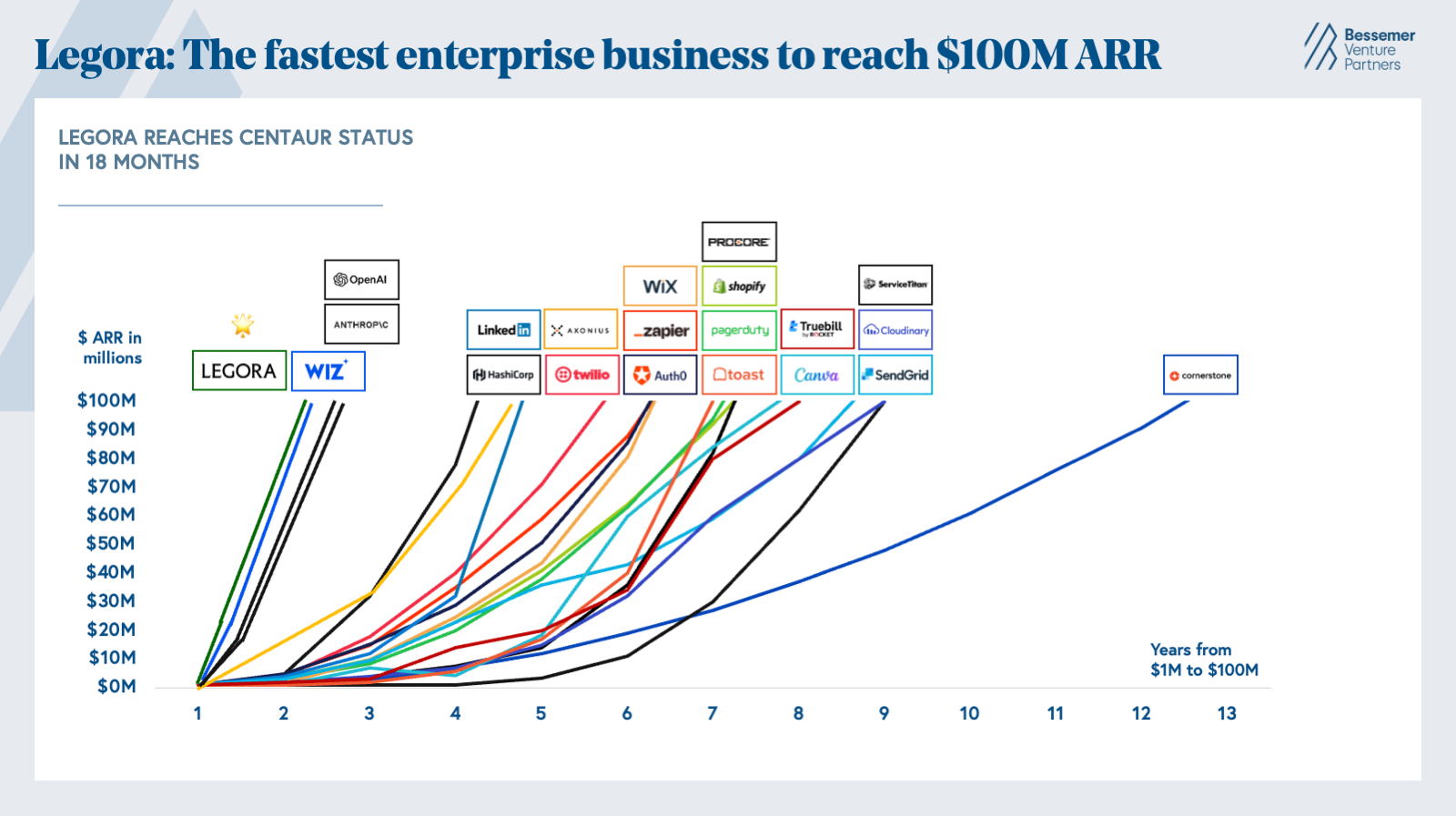
It isn't. Legora is deliberately model-agnostic. The way they describe their own architecture, the model is one swappable layer near the bottom of the stack. Everything that makes the product valuable—the data, the integrations, the legal context and knowledge, the judgment baked into the workflows—sits in the layers around it. The model is the engine. It is not the car.
I love that framing because it's exactly how I think about what we build at Harmonyze. The hard, durable work was never the model. It's assembling the context a coach actually needs, capturing the judgment that turns a number into a decision, and building the system that holds all of it together so it's there every time, regardless of which model is reasoning that day.
Models will keep getting better, and the better they get, the more ambitious you can be. But the quieter advantage of building this way is that when a model gets worse, or slower, or recalled on a Friday afternoon by a directive no one saw coming, you swap it and keep moving. Your customers never feel the tremor.
Last week was a reminder that the tremor is real, and that it can come from a direction no one was watching. So when I see operators racing to attach themselves to whatever model topped the leaderboard this quarter, I get a little nervous on their behalf. The leaderboard is not stable ground. It was never going to be.
The model is the easy part. What you build around it is the whole game.